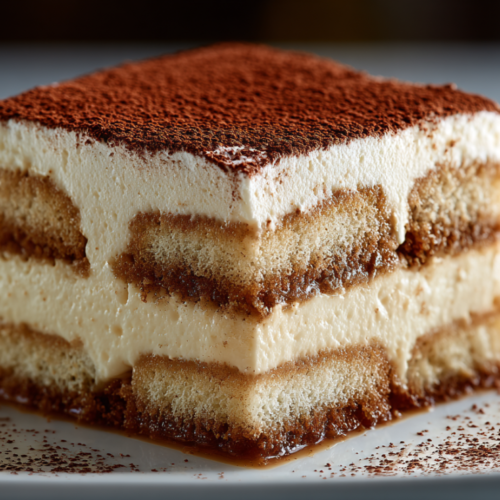
Homemade Tiramisu with Ladyfingers (Classic Italian Method)
A luxurious Italian dessert featuring pillowy homemade savoiardi soaked in espresso and layered with silken mascarpone zabaglione. The key technique is the proper emulsification of egg yolks with sugar over a bain-marie, creating a stable foam that supports the mascarpone without breaking.
Print
Pin
Add to Collection
Servings: 12 servings
Calories: 428kcal
Equipment
Stand mixer with whisk attachment
Double Boiler or Bain-Marie Setup
9x13-inch baking dish
Piping Bag with 1/2-inch Round Tip
Half Sheet Pan
Parchment paper
Instant-read thermometer
Fine Mesh Sieve
Offset spatula
Shallow Bowl for Dipping
Ingredients
For the Ladyfingers (Savoiardi)
- 4 large eggs separated, at room temperature
- 3/4 cup granulated sugar divided
- 1 cup all-purpose flour sifted
- 1/4 teaspoon fine sea salt
- 1/2 teaspoon pure vanilla extract
- Confectioners' sugar for dusting
For the Mascarpone Zabaglione
- 6 large egg yolks at room temperature
- 3/4 cup granulated sugar
- 1/3 cup dry Marsala wine or dark rum
- 16 ounces mascarpone cheese at room temperature
- 1 1/2 cups heavy cream cold
- 1 teaspoon pure vanilla extract
For the Espresso Soak
- 2 cups strong espresso or coffee cooled to room temperature
- 3 tablespoons coffee liqueur such as Kahlúa, optional
- 2 tablespoons granulated sugar
For Finishing
- 3 tablespoons Dutch-process cocoa powder for dusting
- Dark chocolate shavings optional, for garnish
Instructions
Making the Ladyfingers
- Preheat your oven to 400°F (200°C). Line two half sheet pans with parchment paper. Using a pencil, draw 4-inch lines spaced 1 inch apart as piping guides, then flip the parchment pencil-side down.
- In a stand mixer fitted with the whisk attachment, beat the egg yolks with half of the sugar (6 tablespoons) on medium-high speed until the mixture triples in volume and falls in thick ribbons, about 5 minutes. The French call this ribbon stage "ruban." Add the vanilla and beat briefly to combine. Transfer to a large bowl.
- Clean the mixer bowl and whisk thoroughly. Beat the egg whites with the salt on medium speed until foamy. Increase to medium-high and gradually add the remaining sugar. Continue beating until you achieve stiff, glossy peaks that hold their shape when the whisk is lifted, about 4 minutes.
- Fold one-third of the whipped whites into the yolk mixture to lighten it. Sift one-third of the flour over the top and fold gently. Repeat with remaining whites and flour in two additions, folding just until no streaks remain. The batter should be light and hold its shape.
- Transfer the batter to a piping bag fitted with a 1/2-inch round tip. Pipe 4-inch fingers onto the prepared pans, leaving 1 inch between each. Dust generously with confectioners' sugar, wait 5 minutes, then dust again. This double dusting creates the characteristic crisp, pearl-like crust.
- Bake for 10-12 minutes, rotating pans halfway through, until the ladyfingers are golden at the edges and spring back when touched. They should feel dry on the surface but remain slightly soft inside. Cool completely on the pans.
Making the Mascarpone Zabaglione
- Set up a bain-marie: fill a saucepan with 2 inches of water and bring to a gentle simmer. In a heatproof bowl that fits over the pan without touching the water, combine the egg yolks, sugar, and Marsala.
- Whisk the mixture constantly over the simmering water until it reaches 160°F (71°C) on an instant-read thermometer and has thickened enough to coat a spoon, about 8-10 minutes. The mixture should be pale, foamy, and increased in volume by three times. Remove from heat immediately.
- Transfer the zabaglione to a stand mixer and whip on medium-high until cooled to room temperature, about 5 minutes. The bowl should feel cool to the touch.
- In a separate bowl, whisk the room-temperature mascarpone until smooth and creamy, about 30 seconds. Fold the cooled zabaglione into the mascarpone in three additions, using a gentle folding motion to preserve volume.
- In the clean mixer bowl, whip the cold heavy cream with the vanilla to medium peaks. Fold the whipped cream into the mascarpone mixture in two additions until smooth and homogeneous. Refrigerate while you prepare the coffee soak.
Preparing the Espresso Soak
- Combine the cooled espresso, coffee liqueur (if using), and sugar in a shallow bowl. Stir until the sugar dissolves completely. Taste and adjust sweetness if desired.
Assembling the Tiramisu
- Spread a thin layer (about 1/2 cup) of the mascarpone cream on the bottom of a 9x13-inch baking dish. This prevents the ladyfingers from becoming soggy on the bottom.
- Working quickly, dip each ladyfinger into the espresso mixture for 1-2 seconds per side—no longer. The cookie should absorb coffee but maintain structure. Arrange dipped ladyfingers in a single layer over the cream, fitting them snugly.
- Spread half of the remaining mascarpone cream over the ladyfingers in an even layer using an offset spatula. Repeat with another layer of dipped ladyfingers, then top with the remaining cream, smoothing the surface.
- Cover tightly with plastic wrap, ensuring the wrap does not touch the cream. Refrigerate for at least 4 hours, preferably overnight, allowing the flavors to meld and the texture to set properly.
Finishing and Serving
- Just before serving, dust the top generously with cocoa powder through a fine-mesh sieve for even coverage. Add chocolate shavings if desired. Cut into squares with a sharp knife dipped in hot water and wiped clean between cuts for clean edges.
Notes
The ladyfingers can be made up to 3 days ahead and stored in an airtight container at room temperature. They actually improve with a day of rest, becoming slightly drier and better at absorbing espresso.
For food safety, the zabaglione must reach 160°F (71°C) to pasteurize the egg yolks. Use an instant-read thermometer—do not guess.
Room temperature mascarpone is essential. Cold mascarpone will cause the cream to seize and become lumpy when folded with the warm zabaglione.
The tiramisu tastes best on day two, when all flavors have fully integrated. It keeps refrigerated for up to 4 days.
Nutrition
Calories: 428kcal | Carbohydrates: 38g | Protein: 8g | Fat: 26g | Saturated Fat: 14g | Cholesterol: 195mg | Sodium: 85mg | Potassium: 142mg | Fiber: 1g | Sugar: 28g | Vitamin A: 850IU | Calcium: 78mg | Iron: 1mg
Tried this recipe?Mention @EpicureChefts or tag #Chefts!