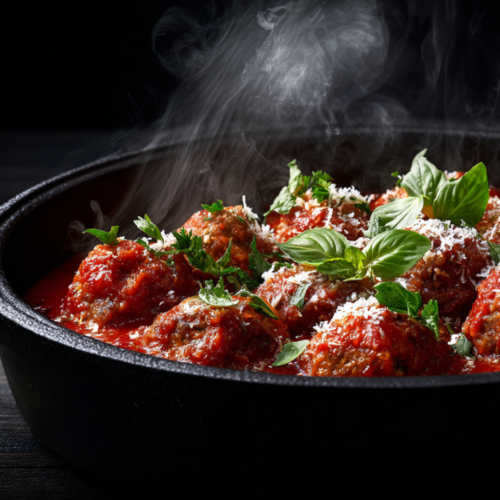
Meatballs in Marinara (Classic Italian-American Style)
Tender, juicy meatballs braised in a slow-simmered San Marzano tomato sauce. The secret is a panade—a mixture of milk-soaked breadcrumbs—that keeps the meatballs impossibly tender while the marinara develops deep, concentrated flavor through patient reduction.
Print
Pin
Add to Collection
Servings: 6 servings
Calories: 485kcal
Equipment
Large Dutch oven or heavy-bottomed pot
Large mixing bowl
Cast iron skillet or heavy sauté pan
Wooden Spoon
Instant-read thermometer
Sheet pan
Wire cooling rack
Ingredients
For the Meatballs
- 1 lb ground beef 80/20 blend
- 1/2 lb ground pork
- 1/2 lb ground veal or additional pork
- 3/4 cup fresh breadcrumbs from day-old Italian bread
- 1/2 cup whole milk warmed
- 2 large eggs beaten
- 1/2 cup Parmigiano-Reggiano finely grated
- 1/4 cup fresh Italian parsley finely chopped
- 4 cloves garlic minced
- 1 1/2 tsp kosher salt
- 1/2 tsp freshly ground black pepper
- 1/4 tsp freshly grated nutmeg
- 2 tbsp extra-virgin olive oil for searing
For the Marinara Sauce
- 2 28-oz cans San Marzano tomatoes whole, DOP certified
- 1/4 cup extra-virgin olive oil
- 1 medium yellow onion finely diced
- 6 cloves garlic thinly sliced
- 1/4 tsp red pepper flakes optional
- 1 tsp dried oregano
- 1 sprig fresh basil plus more for garnish
- 1 tsp granulated sugar if needed
- 1 tsp kosher salt to taste
For Serving
- 1 lb spaghetti or rigatoni cooked al dente
- 1/2 cup Parmigiano-Reggiano freshly grated
- 1/4 cup fresh basil leaves torn
Instructions
Make the Panade
- Combine the breadcrumbs and warm milk in a small bowl. Stir to combine and let sit for 10 minutes until the bread has fully absorbed the milk and forms a thick paste. This is your panade—the secret to tender meatballs.
Mix the Meatball Base
- In a large bowl, combine the ground beef, pork, and veal. Add the panade, beaten eggs, Parmigiano-Reggiano, parsley, garlic, salt, pepper, and nutmeg.
- Using your hands, gently mix until just combined. Do not overwork the meat—you should still see streaks of the individual components. Overmixing develops gluten in the breadcrumbs and myosin in the meat, resulting in dense, rubbery meatballs.
- Cover and refrigerate the mixture for at least 30 minutes (up to overnight). This rest allows the flavors to meld and the mixture to firm up for easier shaping.
Shape the Meatballs
- Using wet hands to prevent sticking, portion the meat mixture into golf ball-sized rounds, approximately 2 ounces each. You should get about 24 meatballs. Roll gently between your palms—three or four rotations is sufficient. Place on a parchment-lined sheet pan.
Sear the Meatballs
- Heat the olive oil in a large cast iron skillet over medium-high heat until shimmering. Working in batches to avoid crowding, sear the meatballs until deeply browned on two sides, about 2-3 minutes per side. The meatballs will not be cooked through—this is intentional. They will finish cooking in the sauce.
- Transfer seared meatballs to a clean plate. Reserve any fond (browned bits) in the pan for the sauce if desired.
Build the Marinara Sauce
- Pour the canned tomatoes into a bowl. Using your hands or a potato masher, crush the tomatoes, leaving some texture—you want a mix of smooth sauce and rustic chunks.
- In a large Dutch oven, heat the olive oil over medium heat. Add the onion and cook, stirring occasionally, until softened and translucent, about 5-7 minutes. Add the sliced garlic and red pepper flakes, cooking until fragrant, about 1 minute.
- Add the crushed tomatoes, oregano, basil sprig, and salt. Bring to a simmer, then reduce heat to low. Cook for 20 minutes, stirring occasionally, until the sauce has thickened slightly and the raw tomato flavor has mellowed.
Braise the Meatballs
- Taste the sauce and adjust seasoning. Add sugar only if the tomatoes are particularly acidic. Gently nestle the seared meatballs into the sauce in a single layer.
- Cover the pot partially and simmer over low heat for 30-40 minutes, gently turning the meatballs once halfway through. The internal temperature should reach 165°F, and the meatballs should be tender enough to cut with a fork.
Finish and Serve
- Remove the basil sprig. Taste the sauce one final time and adjust seasoning as needed. The sauce should coat a spoon and have a rich, concentrated tomato flavor.
- Serve the meatballs and sauce over cooked pasta, topped generously with freshly grated Parmigiano-Reggiano and torn basil leaves. Alternatively, serve with crusty bread for dipping.
Notes
For the most flavorful meatballs, use a combination of beef, pork, and veal. If veal is unavailable, use a 50/50 blend of beef and pork.
San Marzano tomatoes (DOP certified) make a noticeable difference in flavor. Look for the DOP seal on the can to ensure authenticity.
Do not skip the panade—it is the key to tender meatballs. The milk-soaked bread creates pockets of moisture that prevent the meat from becoming dense.
Searing develops crucial Maillard flavor, but the meatballs will finish cooking in the sauce. Do not attempt to cook them through during searing, or they will be overdone by the time the braising is complete.
The sauce and meatballs improve significantly after resting overnight. Consider making this dish a day ahead for the best results.
Nutrition
Calories: 485kcal | Carbohydrates: 18g | Protein: 32g | Fat: 31g | Saturated Fat: 11g | Cholesterol: 145mg | Sodium: 890mg | Potassium: 720mg | Fiber: 3g | Sugar: 8g | Vitamin A: 580IU | Vitamin C: 18mg | Calcium: 185mg | Iron: 4mg
Tried this recipe?Mention @EpicureChefts or tag #Chefts!